| |
Captain Albert Jacka VC MC and Bar
Albert Jacka was born on January 10th, 1893 at Layard near Winchelsea, Victoria, Australia to Nathaniel and Elizabeth Jacka. His siblings were Samuel, Fanny, Elsie, Sidney, William and Bessie. The family moved to Wedderburn, near Bendigo, where Albert grew up, went to school. He worked with his father as a haulage contractor and took up a labouring job with the Victorian State Forests Department. At the outbreak of the Great War he joined the 14th Battalion, Australian Imperial Force, and trained at the Broadmeadows camp near Melbourne before embarking for Egypt as a private for further training. At Courtney’s Post on the Turkish Gallipoli Peninsula in May 1915 he won a Victoria Cross for bravery, which heralded the beginning of a legendary military career.
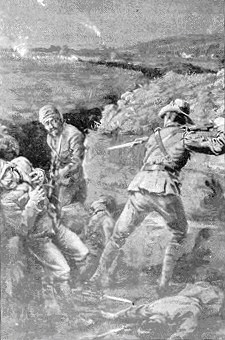
An artist’s impression of Jacka’s VC action at Courtney’s Post, Gallipoli, 19 May, 1915.
(from Stephen Snelling, VCs of the First World War: Gallipoli, Wren’s Park Publishing)
Tributes to Captain Albert Jacka, VC, MC and Bar
From his Brigadier:
“He fought the nation’s battles in the line and fought for his men out of the line. It is right that such a man’s name should be handed down to posterity”
Brigadier-General C.H. Brand
The Argus, 16 May, 1932
From the 14th Battalion’s historian:
“He will never be forgotten by those, like the writer, who were privileged to share his friendship, while the recollection of his splendid courage, high personal honour, and outstanding manhood – equal to that of the greatest heroes of antiquity – will stir the blood of Australians for all time, and will serve as a beacon light to illuminate the future of Australia, that native land that he loved so well and served so nobly.”
Newton Wanliss
Reveille, January 31, 1931
From his friend:
“I often wonder to what heights Jacka would have climbed had he possessed the amiable disposition of either Harry Murray or Percy Black. I think Jacka belonged to an age when it was possible for the individual to challenge with a club the right of leadership in the tribe.
And now, brushing aside several minor achievements, we come to Polygon Wood, where fate gave him the opportunity of directing in the front line, the course of the battle on the 4th Brigade sector. The whole brigade were astonished at the nonchalant bearing of the man: he seemed to be here, there, and everywhere, with not a trace of anxiety or fear. In fact, some men wondered if he possessed a nervous system.”
Captain E.J. Rule
Reveille, January 1, 1935
From his Padre:
He was a soldier with both physical and moral courage of the highest order. He had no hate of the Germans or the Turks in his heart. He hated the necessity of war, but felt it to be a necessity; and he would see his job through.
Rev. F. W. Rolland, MC, MA
Mufti, January 1, 1937
From his CO:
Bert was of medium size and height, wonderfully well built and with an extremely strong face which simply radiated determination, and although I did not meet him until after the evacuation of the Peninsula, I among many others, realised that in this man there was something exceptional.
Afraid of no man whether he be of high rank or otherwise, straight out from the shoulder were his methods whether it be pleasant or otherwise, with whom he was dealing at the time.
He was idolised by first the men of his section, platoon and then company and one hears at the re-unions men saying ‘I was in Jacka’s company.’”
W.L. Wadsworth, Lt-Col., DSO, MC
C.O. 14th Battalion
Mufti, January 1, 1937
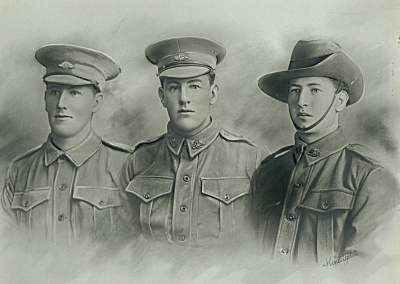
This montage photo of the three Jacka brothers who went to the Great War was owned by their mother, Mrs Elizabeth Jacka, and is now in the possession of Ken Jacka (Sidney’s son). It shows from left to right, William Jacka, Albert Jacka and Sidney Jacka.
Courtesy of Ken Jacka
|
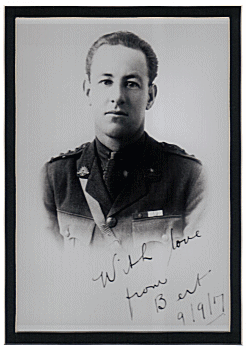
Photograph of Albert Jacka signed ‘With love from Bert 9/9/17’, i.e. a few weeks before the Battle of Polygon Wood.
Courtesy of Jason LaMacchia
|
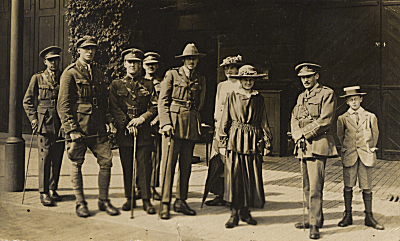
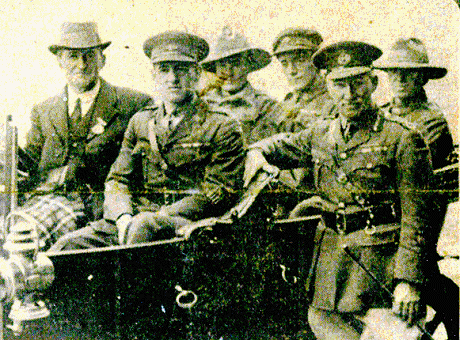
‘Swinging the lead’. Captain Albert Jacka VC MC and Bar (third from left) with a party of sightseers at the Kings Stables in England. First on the left is Captain Albert Taylor who sent this photo to his mother as a postcard, most probably during the northern summer of 1917 (when Jacka was in London recovering from a leg wound inflicted by a sniper). To the right of Jacka stands an Australian officer who had won a Military Cross and lost his left arm. Next to him stands Lady Dorothea Halloway.
Courtesy of E.J. Taylor

Albert Jacka
‘Welcome of welcomes’ for Captain Albert Jacka
Captain Jacka returned to Melbourne on Monday, 20 October, 1919 to a ‘welcome of welcomes’. In this photograph, taken after he had disembarked from the Euripides, Captain Jacka is sitting in the front seat of a car driven by the President of the Royal Automobile Club, Dr. R. E. Weigall, to his left, and the State Commandant of Victoria, Brigadier-General Charles Brand (standing next to the vehicle on his right). Thousands of people crowded roads and the intersection at the Melbourne Town Hall to catch a glimpse of Australia’s greatest war hero.
Courtesy of Mrs. Elizabeth Farrow (nee Jacka), this photograph originally appeared on the front page of ‘The Herald’ newspaper in Melbourne.

Welcome at Clifton Hill
Mrs Elizabeth Jacka in grey skirt, Albert Jacka in uniform on her left, Sidney Jacka to her right. Albert’s sister Bessie Jacka holding his arm. Albert’s aunt Margaret and uncle Ted Waldron (owners of the house in Clifton Hill) stand behind the gate between Albert and Mrs Jacka. Mrs Waldron, who was originally from Wedderburn, was Mrs Jacka’s sister (nee Kettle).
Courtesy of Geoff Crapper
|
